
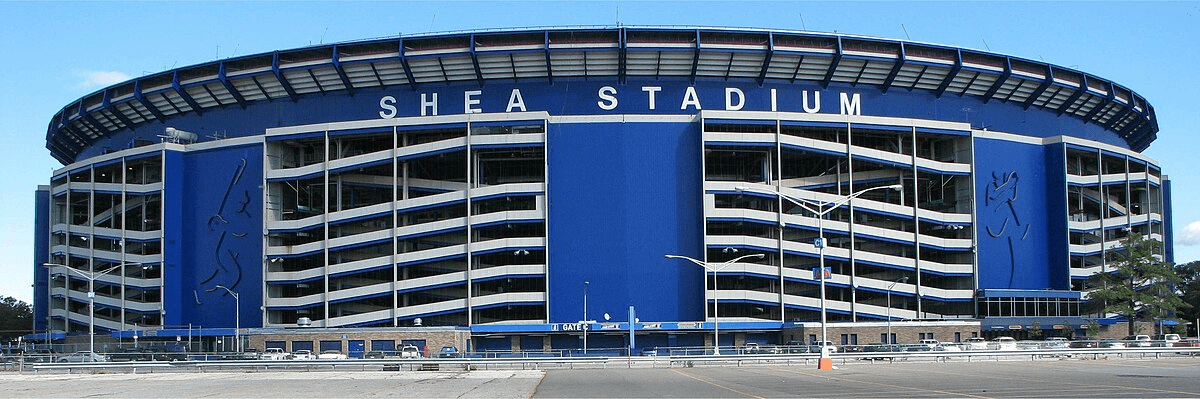
William A. Shea Municipal Stadium, better known as Shea Stadium, opened its doors in New York City in 1964. It quickly became the beloved home of the New York Mets of Major League Baseball and the New York Jets of the American Football League and later the National Football League. The stadium was named in honor of William Shea, a prominent lawyer and philanthropist whose tireless efforts were instrumental in bringing baseball back to New York and reigniting its popularity. Join us as we explore the fascinating history of this iconic New York stadium, which was eventually demolished in 2009, on на new-york-future.
The Push for a New Stadium
In 1957, New York City experienced a significant blow when both the Brooklyn Dodgers and the New York Giants left town. Their departure left the city without a single National League baseball team, a void that ultimately spurred the construction of a new stadium.
Before the Dodgers’ move, city officials had proposed building a stadium for their owner, Walter O’Malley, but he declined. O’Malley wanted to personally select the construction site and finance the project himself, ensuring full ownership of the stadium. This would have given him complete control over revenue generated from its use, but the city authorities weren’t willing to agree. New York City aimed to build a new stadium with public funds and lease it out, directing profits back into the city budget.
Furthermore, O’Malley favored a Brooklyn location for the stadium, while officials insisted on Flushing Meadows. It was at this crucial time that Los Angeles offered the team owner stadium ownership, prompting the Dodgers’ relocation. Simultaneously, Horace Stoneham moved the New York Giants to San Francisco. Thus, two fierce rivals ended up in California, leaving New York without its powerful baseball teams.
Three years later, the National Baseball League agreed to expand a New York franchise, with the condition that a new stadium be built. Mayor Robert F. Wagner Jr. personally assured them this would happen, marking the beginning of what would become Shea Stadium’s story.
Baseball Returns to New York and the Rise of Shea Stadium
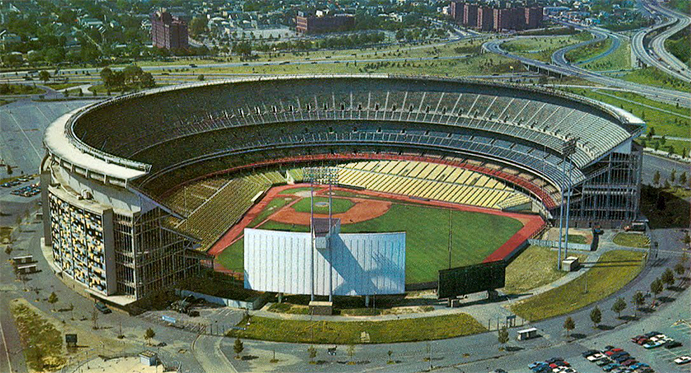
At this stage, the question of the new stadium’s location resurfaced. The owners of the franchise, which would soon become the New York Mets, believed Queens was the ideal spot. They reasoned that building a stadium in one of the previous teams’ boroughs (Brooklyn or Manhattan) might be seen as an attempt to revive those teams. They also had doubts about how fans of the Brooklyn Dodgers and New York Giants would react. A Flushing Meadows location would help avoid these issues and usher in a new chapter for National League baseball in New York.
Additional challenges arose during the financing stage. According to New York State law, the city was prohibited from borrowing funds for new stadium construction. The only viable financing method was to prove that the stadium would be self-sustaining in the future. It was then that New York attorney William Shea, who had championed the return of National League baseball to New York, proposed that the new team pay rent sufficient to cover 30-year bonds. The team agreed but later struggled to meet this condition, leading to significant financial difficulties.
On October 6, 1961, the New York Mets signed a 30-year lease for the new stadium. Construction costs were estimated at $9 million, requiring the team to pay $450,000 in annual rent, with a $20,000 reduction each year until it reached $300,000 annually.
Construction of the new stadium began, and while it was underway, the New York Mets played their inaugural 1962 season in New York at the Polo Grounds. This location was also used by the New York Titans (later the New York Jets) of the American Football League, established in 1960.
According to construction plans, both teams were supposed to move into the new stadium in 1963. The process seemed on track, and the New York Mets representatives were confident it would happen. Only significant unforeseen circumstances could prevent the timely completion of construction. However, those very circumstances arose in the winter of 1962. A severe winter hindered construction, and two subcontractors went bankrupt, leading to labor problems. As a result, both teams remained at the Polo Grounds for another year.
Meanwhile, construction continued. The new stadium was initially planned to be called Flushing Meadow Park Municipal Stadium, but a movement began in the city to name it after William Shea. The idea gained popularity and ultimately won out.
The Grand Opening of Shea Stadium
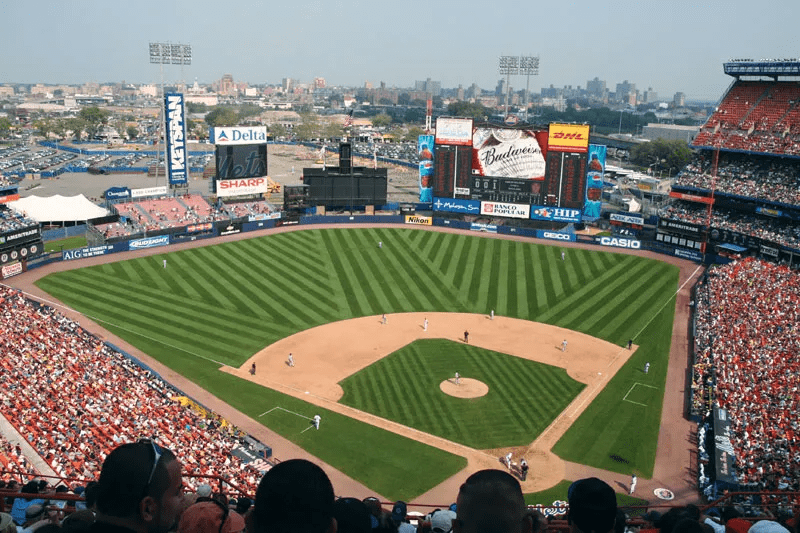
Shea Stadium officially opened on April 17, 1964, after 29 months of construction, at a total cost of $28.5 million. On opening day, the Pittsburgh Pirates played the New York Mets at the new stadium, with the Mets losing 4–3. Over 50,000 spectators were in attendance.
This game marked the stadium’s debut. Construction work was barely completed in time for the event, with only telephone connections still pending at the time of opening.
Interestingly, the new stadium’s opening took place just five days before the 1964–65 World’s Fair. Although not officially part of the fair, the stadium’s exterior was decorated with steel panels in the fair’s blue and orange colors in honor of the event. These colors coincidentally matched the New York Mets’ team colors, which influenced the decision. The panels were only removed in 1980.
From then on, the stadium was actively used, becoming the home of New York baseball and football. It hosted a variety of concerts and entertainment events. It was at Shea Stadium, on August 15, 1965, that The Beatles kicked off their North American tour. The concert drew a massive crowd of 55,600 people, marking their first open-air concert. Its success prompted The Beatles to return for another performance on August 23, 1966. A Grand Funk Railroad concert held there in 1971 even broke The Beatles’ record for ticket sales speed.
Closure and Demolition of Shea Stadium
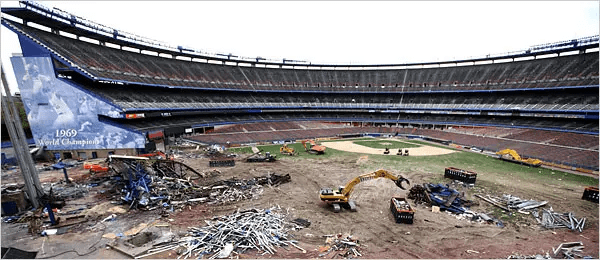
After four decades of continuous use, it became clear that Shea Stadium needed significant renovations or, alternatively, had to be demolished. In accordance with New York law, the decision was made to dismantle it.
Within two weeks of the final game, played on September 28, 2008, seats, signs, and other items of interest to collectors and fans were removed. In October of the same year, demolition began, and by November 10, the field, dugouts, and field-level seating areas were gone.
On January 31, 2009, New York Mets fans gathered at their former home stadium for a final farewell. They toured the grounds, shared personal stories connected to the venue, and sang songs. The last seating section was demolished in February, bringing the story of Shea Stadium to a close.
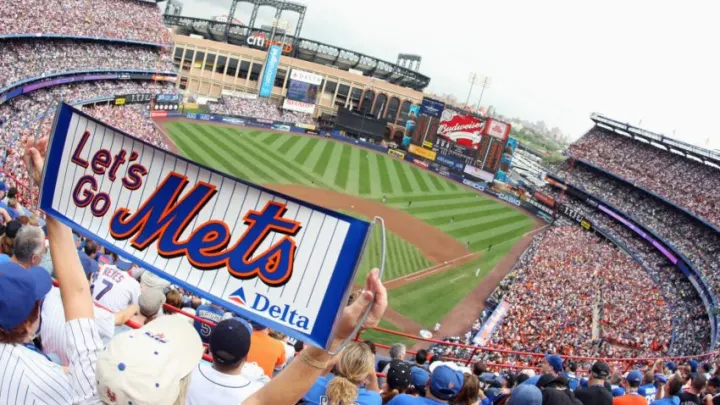
A new baseball stadium, Citi Field, was built adjacent to the former site, where the Mets team relocated. Part of the former Shea Stadium grounds was repurposed for parking. Plaques engraved with images of baseball players that once adorned Shea were installed there, ensuring that the history of National League baseball in New York continues, and fans have a new stadium to watch games and cheer for their favorite team.

