

New York can certainly be called a city of contrasts. It has economically thriving boroughs, strictly touristy spots with countless souvenir shops, historically crime-ridden areas considered unsafe by locals, and boroughs where you can find solitude in nature. However, what captivates almost all residents and visitors is its incredible architecture. St. Patrick’s Cathedral is the largest Catholic cathedral in the United States and is an exquisite example of neo-Gothic style. Located on the famous Fifth Avenue, it welcomes thousands of worshippers from New York and other cities every day. More on new-york-future.
Key Facts from the Cathedral’s History
Construction on the cathedral began in 1858, but the process dragged on for 30 years due to the Civil War—a time when architectural ambitions were put on hold. The structure was built using white and brown marble quarried in New York and Massachusetts. The project was finally completed in 1888, under the guidance of the brilliant architect James Renwick. Throughout its history, the cathedral has been visited by two popes: Pope Paul VI in 1964 and Pope John Paul II in 1979.
Initially, St. Patrick’s Cathedral was located on a vacant lot outside the city, serving as the residence for the Roman Catholic Archbishop of New York. Over time, the metropolis expanded far north of Manhattan, and the cathedral became surrounded by countless skyscrapers, offices, and buildings. Yet, even among this concrete jungle, St. Patrick’s Cathedral looks truly majestic and sacred.
Interestingly, St. Patrick’s Cathedral had an “unfortunate” predecessor of the same name. The first St. Patrick’s Cathedral was built in 1815, but at the time, there was fierce conflict between Protestants and Catholics. While the majority of the city’s residents were Protestants until the 19th century, the situation changed dramatically when a large wave of German and Irish immigrants arrived. The first cathedral became a place where Catholics had to defend themselves from attacks by local gangs, so much so that it was even enclosed by a tall stone fence. Later, in 1853, Archbishop John Hughes decided to build a new cathedral outside the city, promising that one day it would become the heart of New York. Few people believed this idea was a good one, but the archbishop was right.
Architectural Features of the Cathedral
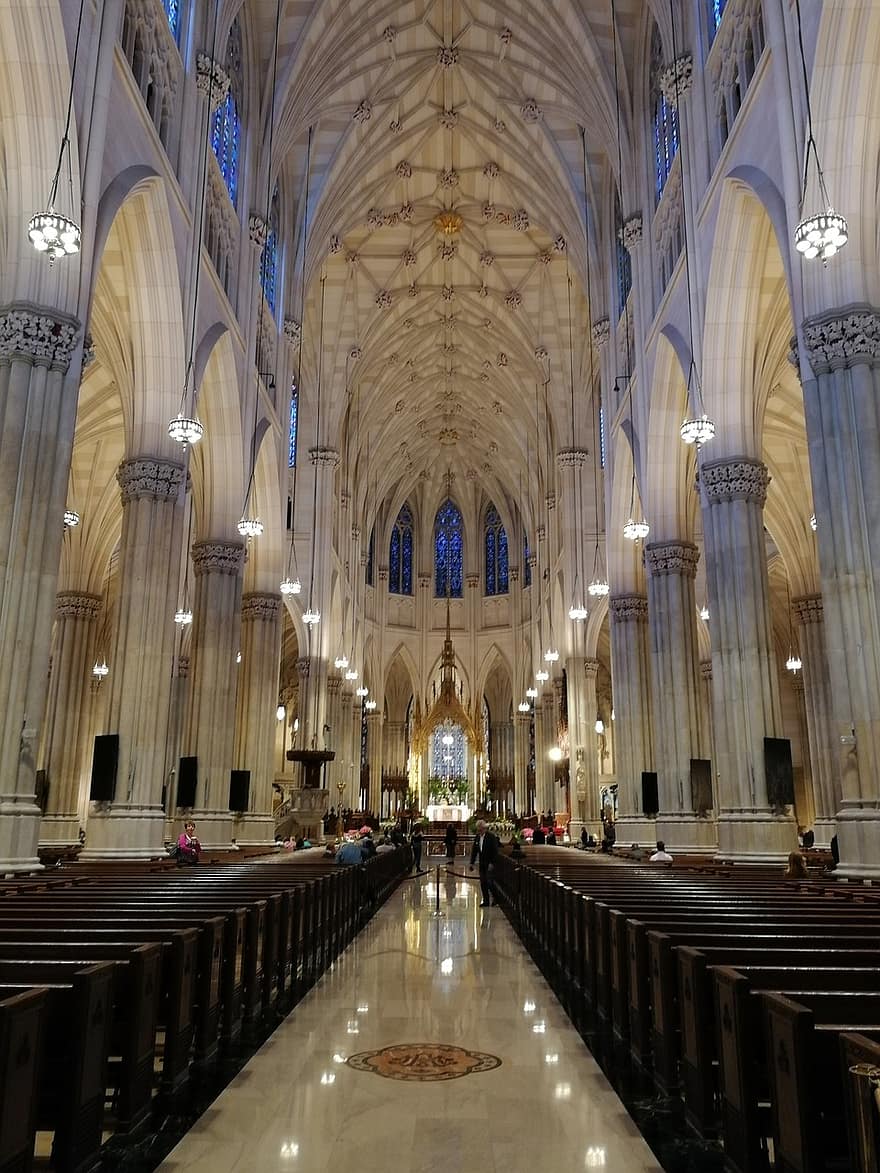
St. Patrick’s Cathedral is shaped like a Latin cross and can accommodate 2,200 people at once. The spires on the structure were installed a decade after it officially opened. The cathedral has several chapels, two of which were built by Italian artisans: the Lady Chapel, St. John the Baptist, and St. Elizabeth. Inside, you can see a bust of John Paul II and a Pietà by the famous sculptor William Partridge, who managed to surpass the size of Michelangelo’s Pietà in St. Peter’s Basilica in the Vatican. The altars of St. Michael and St. Louis were commissioned from the artisans of the famous jewelry brand Tiffany.
The main bronze gates of St. Patrick’s Cathedral face Fifth Avenue and weigh over 18 tons. They feature images of saints, including Elizabeth Ann Seton, the first American-born citizen to be canonized by the Catholic Church.
The cathedral looks enchanting in the afternoon when sunlight streams through the main stained-glass window, which is eight meters long. Visitors can see for themselves that the interior is a true work of art, with every detail holding special meaning.
In 2012, St. Patrick’s Cathedral underwent a major restoration. The acting Archbishop of New York at the time announced that the 135-year-old building was in disrepair. The renovation began in March 2012 and continued for five years, with an estimated cost of 175 million dollars.