

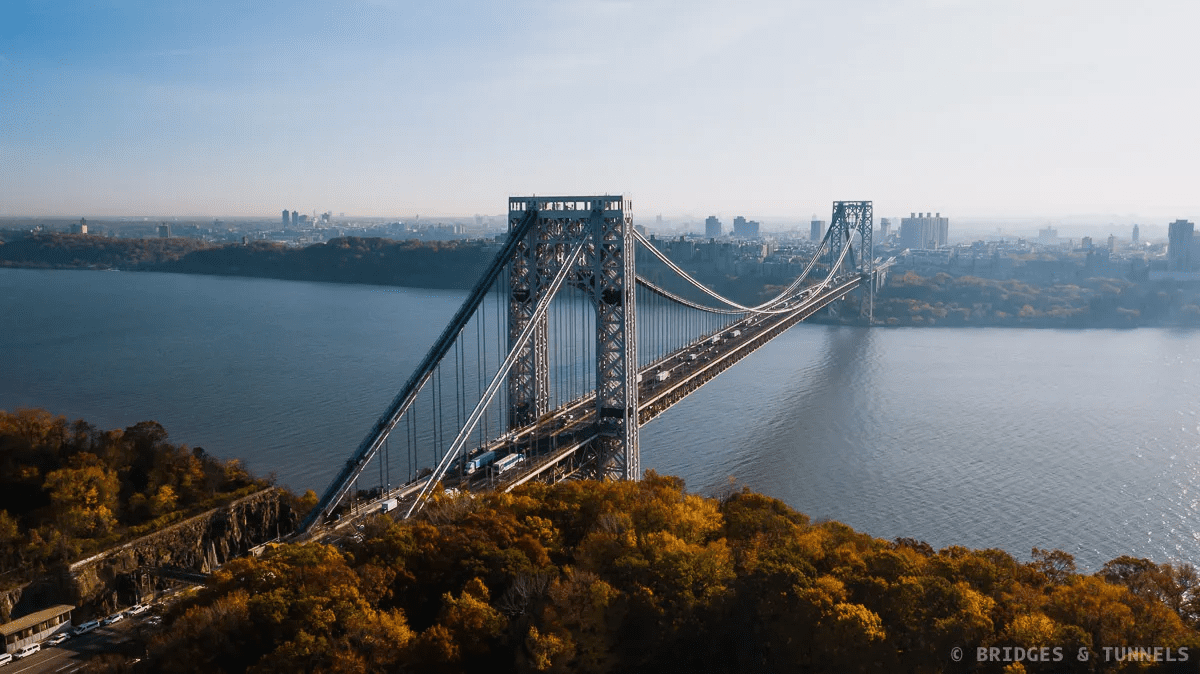
New York’s George Washington Bridge is considered the busiest vehicular bridge in the world. Anyone living in New York or New Jersey is usually not a big fan of the bridge, simply because it’s a complete traffic nightmare. It doesn’t matter the day or time—seven days a week, almost twenty-four hours a day (with the exception of perhaps early Sunday mornings), New York residents and tourists will find themselves stuck in traffic on the George Washington Bridge.
In fact, the traffic is often even worse on the Cross Bronx Expressway in the Bronx or on Route 80 or 95 in New Jersey, as everyone tries to get onto the George Washington Bridge. Traffic aside, the Washington Bridge is a spectacular feat of human engineering. This article will cover the history of the bridge’s creation and its unique features. Read more at new-york-future.
Building the Bridge
The world-famous George Washington Bridge was opened on October 25, 1931. Before its creation, there were numerous proposals for building a bridge across the Hudson River. Between 1866 and 1927, six different companies proposed eighteen different designs, and five different locations were considered. One early proposal included rail traffic on the bridge using a cantilevered design. Over time, tunnels were built from lower Manhattan to New Jersey for rail traffic, which led to the bridge’s location being moved upriver.
In 1890, a law was passed in New York requiring that any bridge construction have no piers in the river, as this would obstruct river transportation of goods between New York and small towns along the Hudson River like Albany, Garrison, and Tarrytown. In 1925, New York and New Jersey passed legislation to build, operate, and maintain a bridge across the Hudson River between 170th and 185th Streets. In August 1926, Governor Silzer and Governor Smith approved the construction of a suspension bridge connecting the two states.
The first discussions and questions about how to build the suspension bridge were quite interesting. Two types of suspension bridges were discussed: a wire design and a bracket design. The cantilevered design was two and a half times heavier than the wire cables and had the advantage of greater rigidity, so it was decided to use it instead. Othmar Ammann, the engineer of the George Washington Bridge, was a visionary. He insisted that the bridge be adaptable to any future needs because it was a structure meant to last. The bridge was planned to be built in three phases. The first phase was to satisfy the current needs of connecting New York and New Jersey for vehicle traffic. The second phase was to complete the construction of the lower level. The third and most important phase was to build a bridge that could withstand the weight of both the upper and lower levels.
The bridge’s groundbreaking ceremony took place on September 27, 1927. Representatives from the Port Authority, as well as state and municipal officials, gathered for the occasion in Fort Lee, New Jersey, and Fort Washington Park at the foot of 178th Street. The event was broadcast on WOR-AM radio. The initial cost of the bridge and its approaches was $60 million. Construction lasted four years and was completed eight months ahead of schedule, saving $1 million.
The span from anchorage to anchorage is 4,760 feet, and the towers are 630 feet high. The bridge is 119 feet wide, and the clearance at the middle of the span is 213 feet above the water.
The Opening of the George Washington Bridge
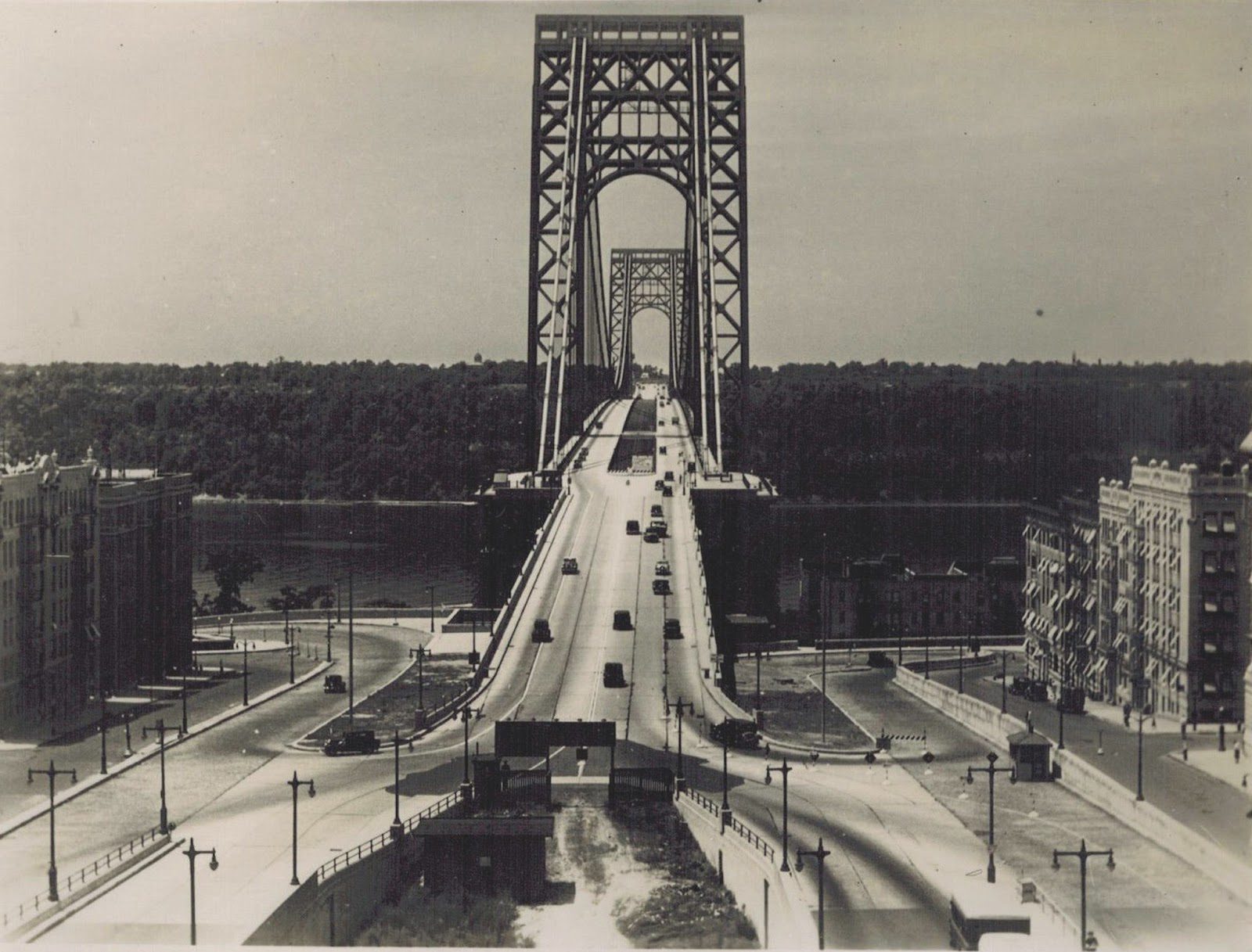
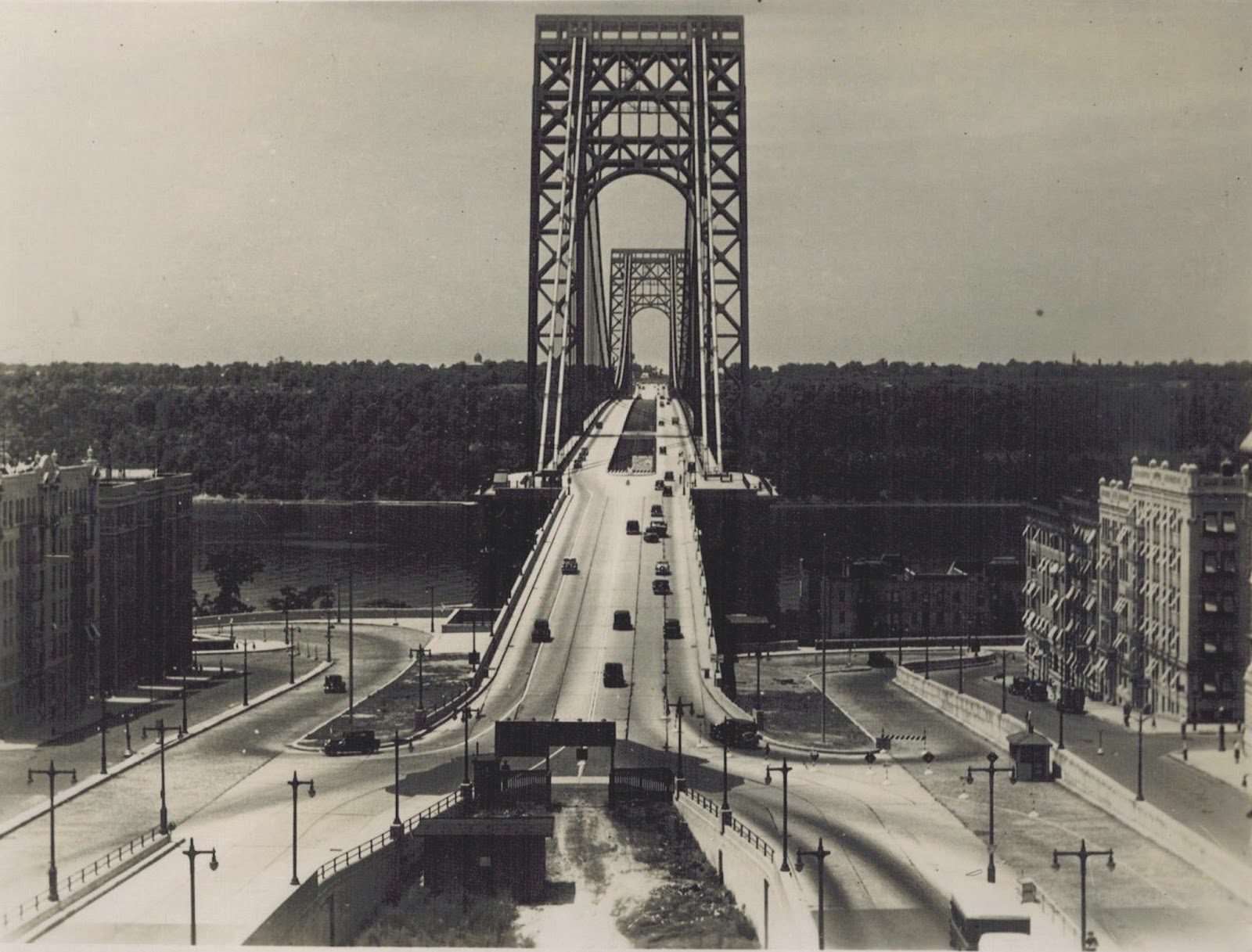
On October 25, 1931, the bridge was officially opened to vehicular and pedestrian traffic. At the ceremony, Governor Franklin Delano Roosevelt called the bridge a “superhuman perfection.” When the bridge finally opened to vehicle traffic, 55,000 cars crossed it on the first day. Morton Salomon, a bit of an adventurer, rode across the bridge on horseback. After the structure’s completion, traffic problems arose in Fort Lee and Washington Heights.
Highways had to be built to compensate for the traffic in New Jersey. In New York, under the leadership of Robert Moses, the West Side Highway was built to connect lower Manhattan to the bridge. Two tunnels were constructed in Washington Heights to connect traffic from the bridge to highways and bridges on the East River. The tunnel under 178th Street connected traffic to the Harlem River Drive. The tunnel under 179th Street served traffic coming from the east side. Initially, the tunnel had six lanes, and the central section remained undeveloped. In 1946, traffic had increased so much that two additional lanes were built in the undeveloped central section. Under the roadway on the towers, there was still space for rail traffic.
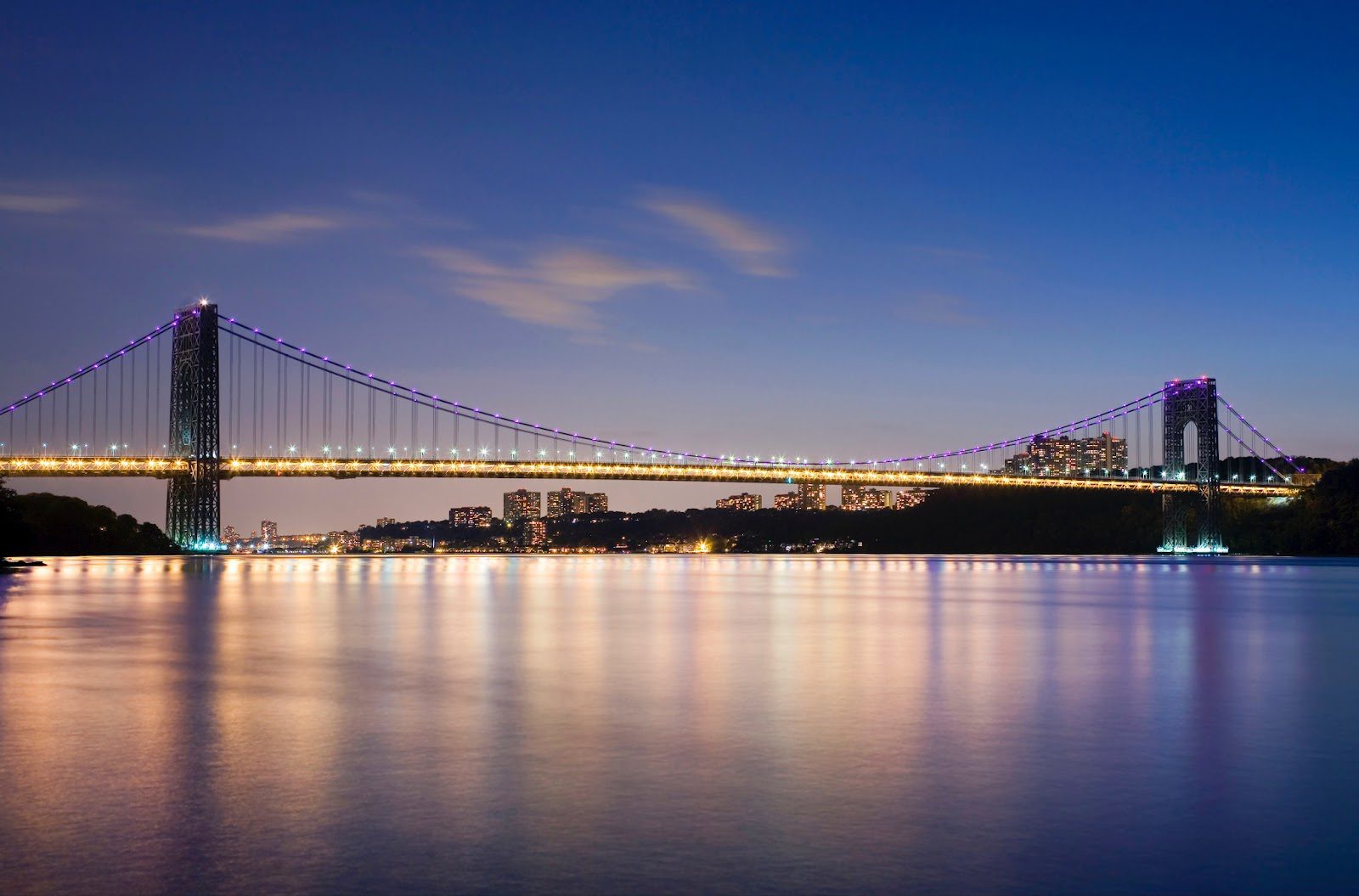
Recently, at least 400 halogen lamps were installed on the towers. These lights replaced the ones used until the 1980s, which lit up the towers from the ground. The bridge continues to play a dominant role as a key route connecting New York and New Jersey to other parts of the Northeast and the rest of the country.
The Importance of the George Washington Bridge
First and foremost, the George Washington Bridge is a symbol of technology and progress. The construction of this structure shows just how far humanity has come in its ability to create large and complex structures. The building of the George Washington Bridge and its subsequent expansion is a true testament to the fact that people can overcome even the biggest challenges to achieve their goals. When writing about the bridge’s significance, you can’t ignore its impact on daily life. For residents of New York and New Jersey, the George Washington Bridge has become an indispensable part of their daily routine. While we mentioned earlier that there are crazy traffic jams on the bridge at all hours of the day, the structure has significantly simplified and sped up daily commutes. Before, residents had to take a ferry to get to the other side of the river, which took a long time and was heavily dependent on weather conditions. The bridge also ensures the seamless movement of people and goods, which is of enormous importance to the region’s economy. It’s no secret that the George Washington Bridge is one of New York’s top tourist attractions. Its amazing size and majestic structure make it one of the most recognizable places in the United States. Tourists come to admire the incredible view, take souvenir photos, and learn many interesting facts about the structure.
Interesting Facts About the George Washington Bridge:
- The American Flag. One of the most recognizable features of the George Washington Bridge is the huge American flag that proudly flies under the pylon on the New Jersey side. It’s known to be the largest flag of its kind in the world, symbolizing patriotism and national pride. According to information published online, the flag is raised on special occasions, such as Independence Day and Veterans Day, giving the bridge even greater symbolic significance.
- Records and Accolades. This massive structure is not without its records and accolades. On October 24, 1931, the George Washington Bridge was the longest suspension bridge in the world. The length of the bridge’s span was over a kilometer, which was an incredible engineering achievement for its time. Even in the 21st century, the George Washington Bridge remains one of the most important and recognizable bridges in the world, even though many other cities have larger structures.
- The Bus Stop. In most cases, it’s forbidden for public transport to stop on a bridge, as it is dangerous for both passengers and other road users. But the George Washington Bridge has a bus stop, #4211, which is a vital point in the public transport network. The stop meets all standards and requirements and is completely safe to use. Thanks to the bus stop, passengers can easily use the bridge without a personal car, making it even more accessible and convenient for all users, as not every tourist travels by car.