
Trillions of dollars pass through Wall Street every day in deals that affect not only the US but also global markets. This is the epicenter of major stock exchanges, banks, and investment giants, where every market fluctuation instantly ripples across the globe. Wall Street is the pulse of the global economy, capable of both uplifting and destabilizing entire financial systems. In this article on new-york-future.com, we explore the evolution of the world’s most influential street, tracing its journey from a colonial wall and a slave market to the birth of the global banking system and the era of AI.
New Amsterdam’s Line of Defense
The story of Wall Street isn’t just about money; it’s a tale of physical survival. In 1653, New Amsterdam—a tiny settlement on the edge of a wild continent—found itself trapped between Europe’s geopolitical ambitions and a harsh local environment. Peter Stuyvesant, the stern director-general of the Dutch colony, faced the looming threat of an English attack from the north. His solution was radical: build a defensive wall to cut off the southern tip of Manhattan from the rest of the island.
Spanning roughly 2,340 feet (710 meters), this structure was built by 40 enslaved Africans and local colonists. It was a 12-foot palisade made of sharpened logs, reinforced by earthen mounds and bastions. But architectural ambitions often clashed with everyday realities. Historical archives hold comical yet entirely serious complaints from the era: roaming pigs, foraging freely through the colony, were rooting up the base of the wall for food, putting the entire city’s safety at risk. This led to the name Het Cingel (The Belt), which the British renamed Wall Street after seizing the city in 1664.
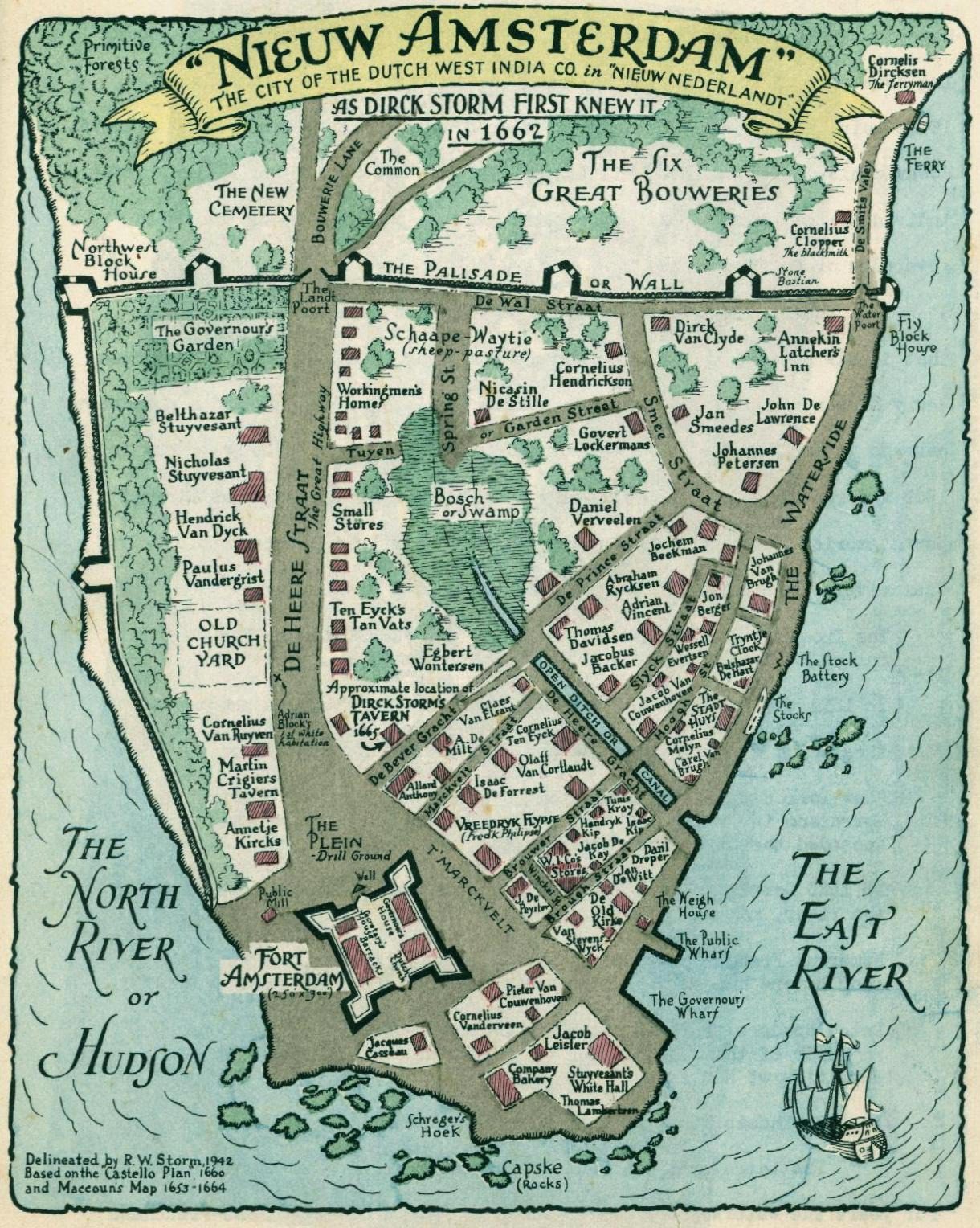
Today, looking at the 1660 Castello Plan, we see a compact miniature of Amsterdam complete with canals and windmills, its northern boundary clearly defined by this barricade. Although it was dismantled in 1699 to make room for a growing city, the wall left behind more than just a name. It instilled a “boys’ club” mentality where security and community interests trumped everything else. Right here, on the site of a former defensive perimeter, the foundation for the planet’s future financial architecture began to take shape.
From a Slave Market to a Presidential Inauguration
In the 18th century, Wall Street transformed into a complex hub where politics, commerce, and human tragedy intertwined. Few realize that for over half a century—from 1711 to 1762—an official municipal slave marketoperated here. At the corner of Wall and Pearl Streets, human beings were bought and sold. The city directly profited from this trade, collecting taxes on every transaction. The wealth generated from forced plantation labor and maritime shipping became one of the primary funding sources for New York’s early banking institutions.
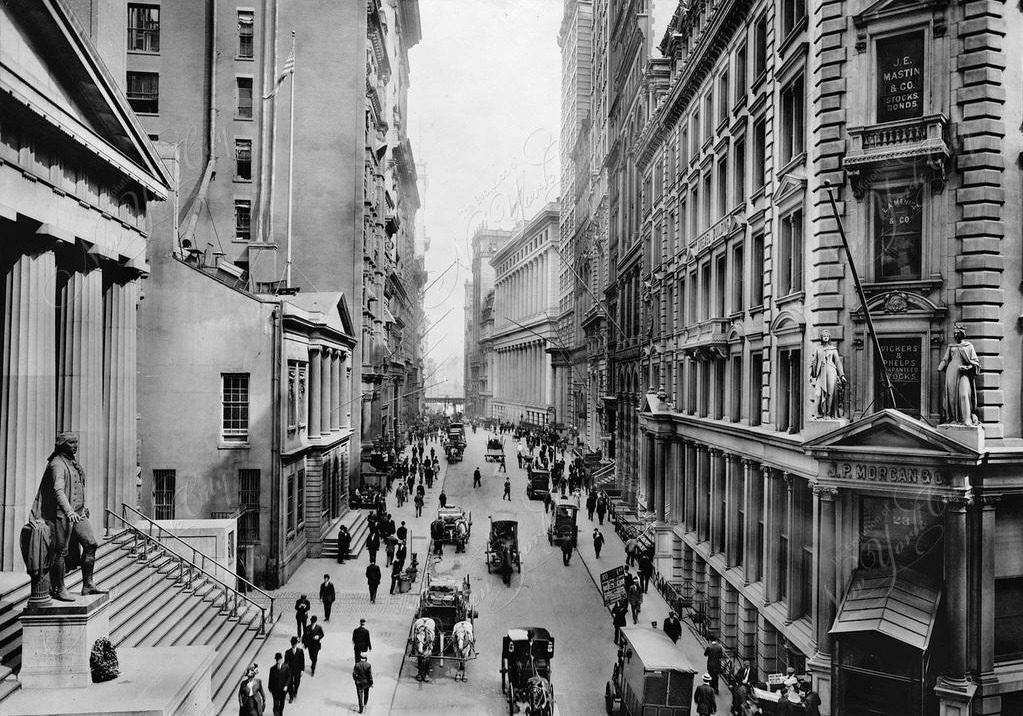
At the same time, the street was becoming the political heart of a new nation. City Hall, later known as Federal Hall, set the stage for events of epic proportions. On April 30, 1789, George Washington stood on its balcony and took the oath of office as the first President of the United States. It was here that the First Congress drafted and passed the Bill of Rights, the document guaranteeing fundamental American freedoms.
It was also here that Alexander Hamilton, the first Secretary of the Treasury, unveiled his brilliant plan for a national credit system. He knew that for the fledgling country to survive, its debt had to become tradable and serve as a foundation of trust. This merging of politics and finance on a single street cemented New York’s destiny—not just as the nation’s temporary political capital, but as the permanent capital of global wealth.
The Buttonwood Agreement and the Coffee Scent of Capitalism
Until the late 18th century, trading on Wall Street was the Wild West. Speculators gathered under a sprawling buttonwood tree outside 68 Wall Street to trade government bonds and early bank stocks. It was pure chaos: prices were easily manipulated, and deals routinely fell through. Everything changed on May 17, 1792, when 24 brokers signed the historic Buttonwood Agreement.
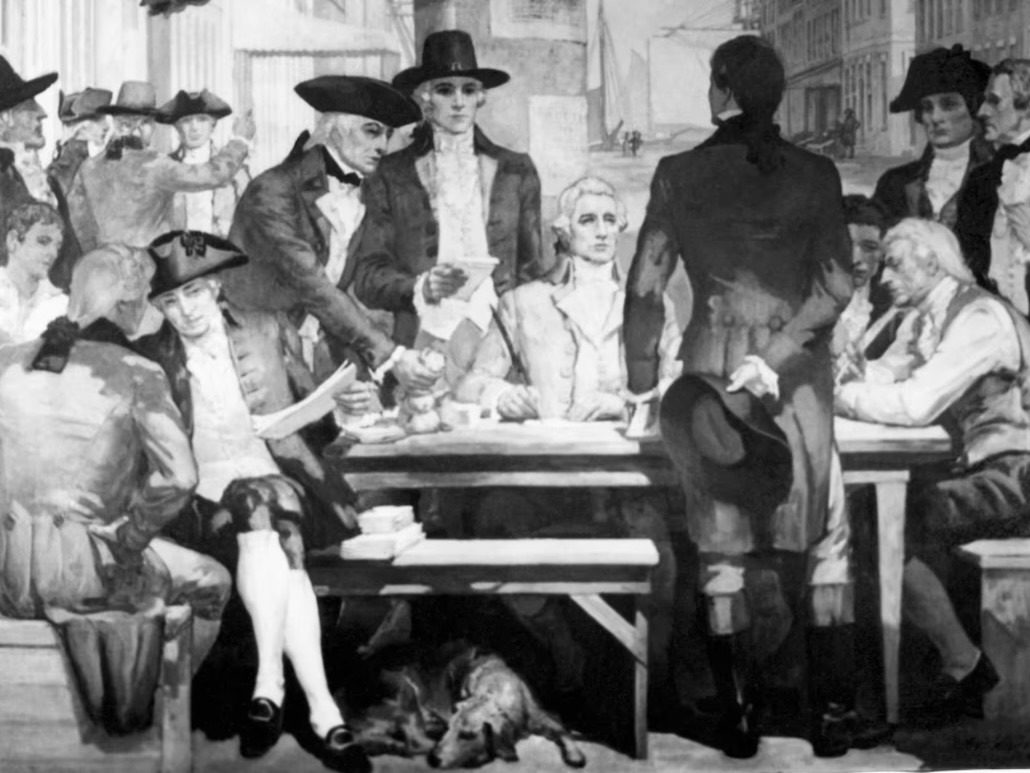
This brief, one-page document essentially served as the constitution for the New York Stock Exchange (NYSE). The brokers agreed to trade only with each other and to maintain a fixed commission rate of 0.25%. This created a system of mutual accountability and strict professional ethics.
When the weather turned sour, traders moved indoors to the Tontine Coffee House. Back then, coffee was the ultimate fuel for business. In rooms thick with tobacco smoke and the smell of roasted beans, men debated the arrival of ships from China, the price of cotton, and the latest political developments from Europe. Information became the ultimate commodity. Whoever was the first to learn about the outcome of the Battle of Waterloo or a devastating hurricane in the Caribbean stood to make millions. That is how Wall Street bred its culture of an information edge—a culture that has since evolved into high-frequency trading algorithms.
The Industrial Boom and the Great Depression
The 19th century turned Wall Street into the engine of the Industrial Revolution. The opening of the Erie Canal made New York the premier port of the world, and Wall Street banks became America’s primary lenders. The street began to build upward. It saw the installation of the first telegraph lines, and in 1867, the stock tickermade its debut. This device permanently severed the tie between time and distance: an investor in Chicago could now watch a stock price fluctuate at almost the exact same moment as a broker in Manhattan.
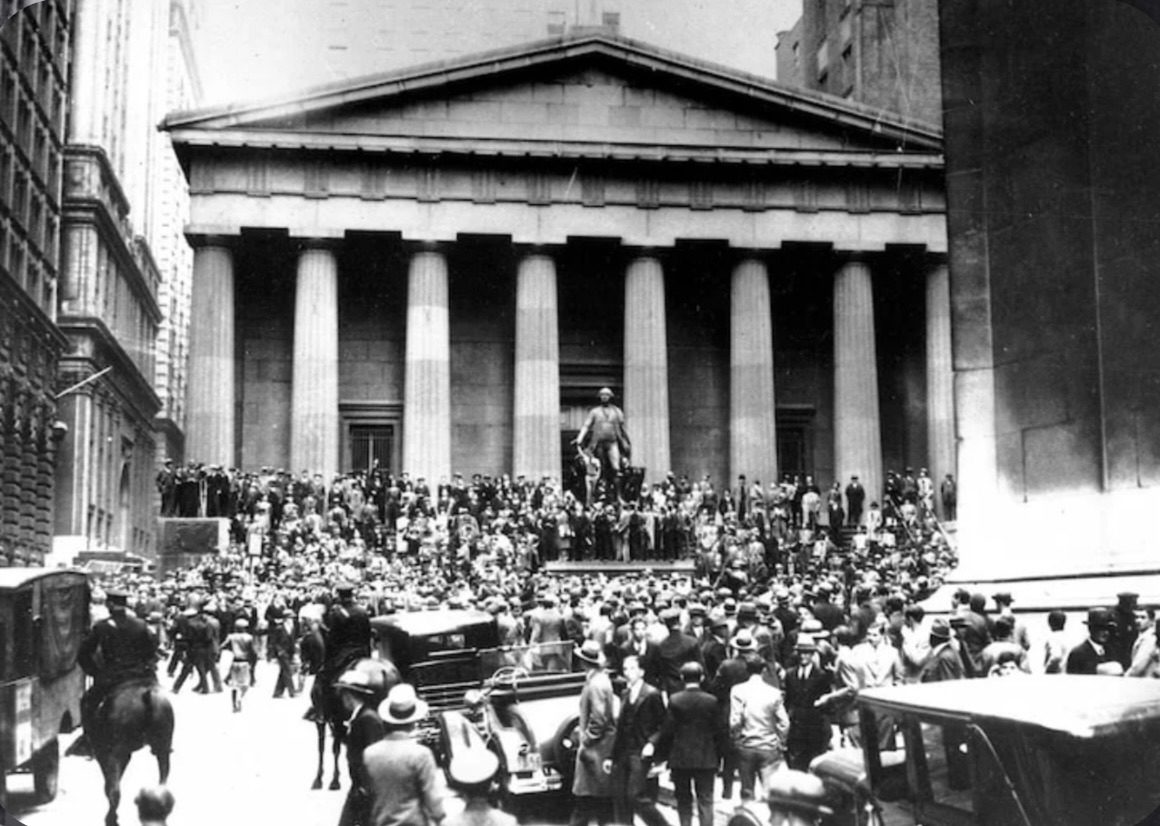
This was the era of financial titans. Take J.P. Morgan, for example. His office at 23 Wall Street (widely known simply as The Corner) didn’t even have a name on the door—everyone already knew exactly who worked there. During the Panic of 1907, Morgan effectively bailed out the U.S. economy. His authority was so absolute that he could single-handedly halt a banking crisis by locking the country’s top bankers in his private library until they hammered out a solution.
However, the roaring growth of the 1920s—when every cab driver and shoeshine boy was buying stocks on margin—inevitably led to disaster. “Black Thursday” on October 24, 1929, marked the beginning of the end for an era of unbridled optimism. The Wall Street Crash triggered the Great Depression. This tragedy proved a harsh truth: Manhattan’s financial heart pumps blood to the entire world, and if it stops, global paralysis follows. In the wake of this fallout, the Securities and Exchange Commission (SEC) was established, aiming to tame cowboy capitalism with strict regulations and transparency.
Wall Street as a Virtual Reality
In the second half of the 20th century and the early 21st, Wall Street made the biggest leap in its history: it stopped being just a geographic location. Starting in the 1970s, the chaotic trading floors of the NYSE gradually began giving way to computer terminals. The launch of the NASDAQ system in 1971 definitively proved that a stock exchange could thrive without a physical trading floor.
Today, the real Wall Street exists inside massive data centers in New Jersey. Servers there are positioned as close to fiber-optic cables as possible to shave mere microseconds off signal times. Modern trading is a ruthless war of algorithms and artificial intelligence. Human beings are no longer physically capable of reacting at the speed of the market. Most major banks, like Goldman Sachs or JPMorgan Chase, moved their primary operations to Midtown or outside of New York City long ago, leaving behind only executive offices and museums on the historic street itself.
Even so, Wall Street remains the most powerful financial brand in the world. It has survived the 9/11 attacks, the 2008 financial crisis, and the disruptive challenges of cryptocurrency decentralization. Even though money has largely turned into digital zeroes in cloud storage, the mere mention of this short, narrow, and often gloomy street continues to inspire awe, fascination, and fear.
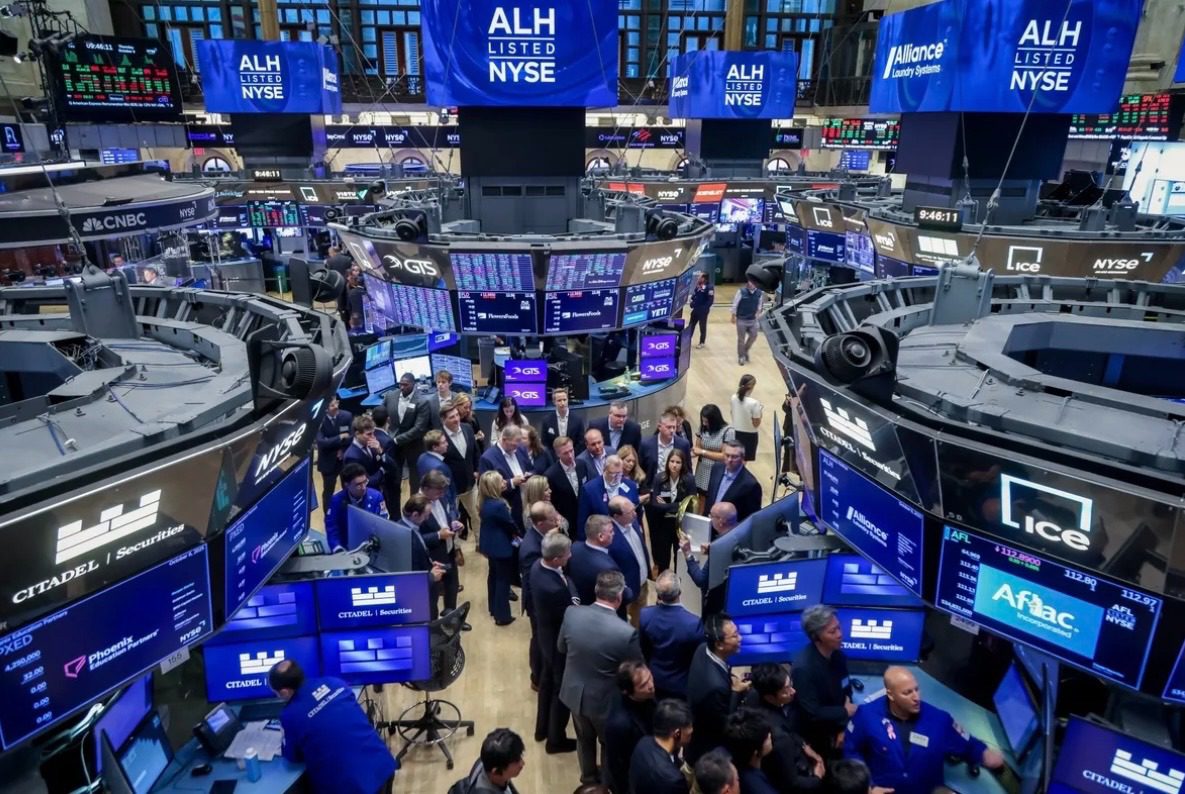
Wall Street is far more than a brief stretch of pavement. It is a living organism that constantly sheds its old skin. It began as a crude barricade against the wilderness and enemy forces, only to evolve into a complex engine driving human civilization. Its history teaches us a core truth: capital always seeks safety, speed, and an information edge. From the pigs rooting under a wooden Dutch wall to the AI managing the retirement funds of millions, Wall Street’s journey mirrors the complexity, cynicism, and grandeur of the human pursuit of progress. This street never sleeps, because the world it bankrolls cannot afford to stop for even a second.

