

At its peak, the “Horn & Hardart” fast-food chain was the largest in the world. Its 180 restaurants served 800,000 customers every day. Yet, this wasn’t just about a quick bite; it was about quality, delicious, and affordable food in a comfortable space. For just five cents, you could get macaroni and cheese or baked beans, creamed spinach, or a cup of aromatic, fresh-ground coffee. They also created the concept of takeout food. Learn more about the rise and fall of New York’s first fast food at new-york-future.
It All Started with a Cup of Coffee
Joseph Horn and Frank Hardart opened their first 15-seat eatery in Philadelphia in 1888. The cozy café had an innovative feature: an aromatic coffee that quickly gained a reputation as the best in the city.
Within a year, the entrepreneurs officially registered the “Horn & Hardart Baking Company,” expanded their menu, and opened several more locations. Their focus, besides coffee, was on delicious, high-quality food. The goal was to feed customers so well that they would undoubtedly want to return.
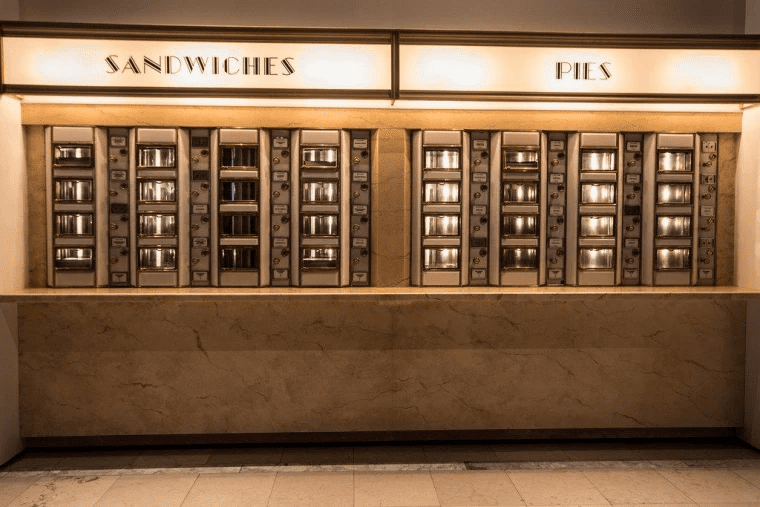
In 1902, Horn and Hardart introduced the first “Automat” in the US. It was installed on Chestnut Street in Philadelphia. They borrowed the idea from Germany: dishes were placed in special vending machines behind small glass doors. Customers would look through the windows, insert a nickel into a special slot, and receive their chosen item. No waiters, no fuss—just instant gratification in a futuristic atmosphere.
In the center of the establishment was a change booth to exchange bills for nickels, and workers in a hidden kitchen constantly restocked the machines with fresh food. Meals were never left to be sold the next day, and fresh orange juice was discarded if not sold within two hours.
It’s worth noting that dishes were served on real plates with metal cutlery, and drinks in glassware. There was never any plastic in these establishments. Instead, a simple and refined elegance prevailed.
The chain expanded to New York 10 years later. In 1912, the first “Automat” opened in Times Square and quickly became a cultural icon. Over the following decades, more than 100 “Automats” opened in the city, serving a wide array of dishes, from hot pies to fresh salads.
What Was on the “Automat” Menu?
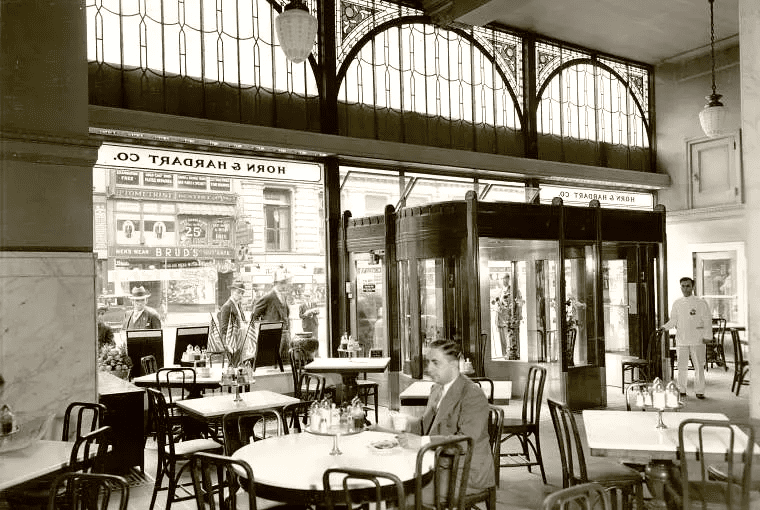
Horn and Hardart presented the public with more than just vending machines; they were true culinary marvels. Their menu featured over 400 items, including savory pies, creamed spinach, baked beans, and desserts like tapioca pudding.
The soups, macaroni and cheese, mashed potatoes, and “Horn & Hardart” coffee—which flowed from elegant, dolphin-head-shaped spigots—became legendary. In the mid-20th century, the chain served over 90 million cups a year!
By the way, examples of the menus can now be viewed on the New York Public Library’s website. What’s more, anyone can now recreate these classic comfort food dishes at home thanks to the book “The Automat: The History, Recipes, and Allure of Horn & Hardart’s Masterpiece.” Written with the participation of Frank Hardart’s great-granddaughter, Marianne Hardart, it serves as a guide to the iconic dishes and history of America’s first fast-food chain.
The “Automat” and Art: A Cultural Icon
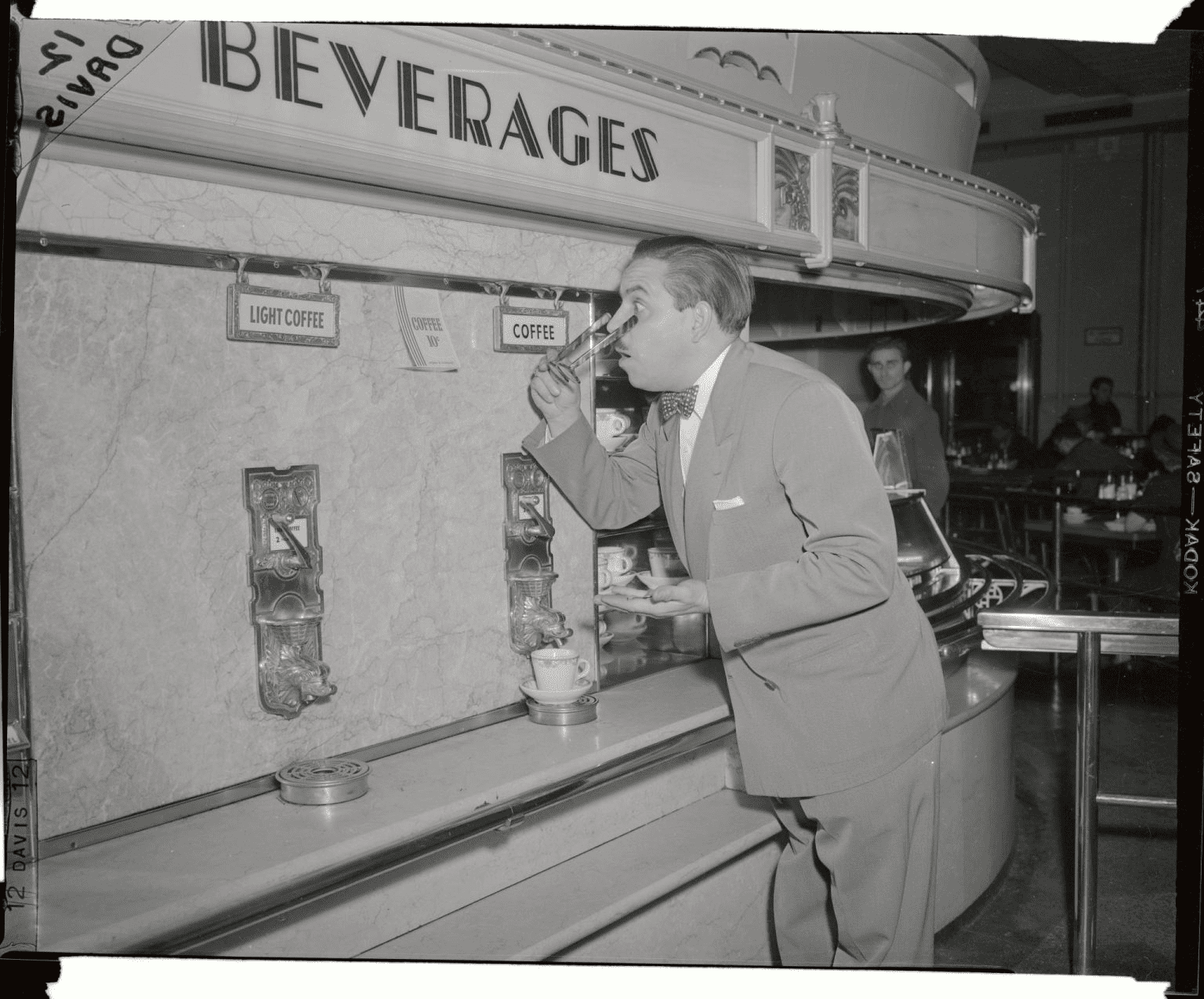
Why do we speak of this fast-food joint as a cultural icon of the last century? The fact is, thanks to their widespread popularity, “Automats” truly became a symbol of New York life and appeared in films, music, and pop culture:
- Irving Berlin’s tune from the musical “Face the Music” (1932) was titled “Let’s Have Another Cup of Coffee” and celebrated the “Automat” as a place of comfort during the Great Depression.
- In the film “Gentlemen Prefer Blondes” (1953), Marilyn Monroe’s character delivers the iconic line: “A kiss may be grand, but it won’t pay the rental on your humble flat, or help you at the Automat.”
- The romantic comedy “That Touch of Mink” (1962) features several scenes set in an “Automat.”
- In his debut film “Hercules in New York” (1970), Arnold Schwarzenegger praises the food from an “Automat,” calling it “fit for the gods.”
In the second half of the 20th century, the popularity of “Automats” declined, but they remained in the city’s memory, as evidenced by numerous mentions in cinema and the press of the time.
The Decline and End of the “Automat” Era
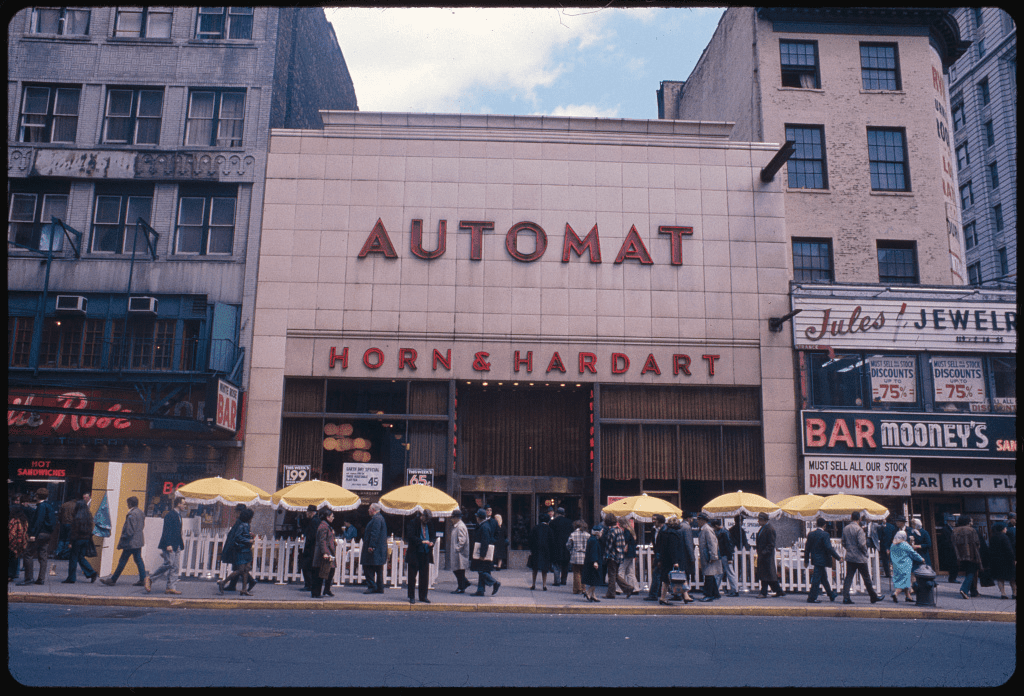
Like any venture, the “Automats” experienced a rise, a peak, and a decline. In the 1950s, suburbs began to grow, drive-thru fast-food chains emerged, and “Automats” slowly lost ground. Inflation in the 1970s contributed to rising food prices, and paper currency began to replace coins. By the 1990s, “Automats” had transformed from a convenient dining option into a nostalgic memory.
Despite attempts to modernize and update the menu, the last “Horn & Hardart” location in New York closed in April 1991. Since then, the “Automats” have remained only in the warm memories of city residents and museum archives.
For instance, the Smithsonian’s National Museum of American History has an original “Horn & Hardart” Automat section first unveiled in Philadelphia in 1902. Additionally, the New York Public Library featured a reconstructed “Automat” wall as part of its 2013 exhibition “Lunch Hour NYC.” Visitors could peek into the area where workers loaded food and open the glass doors, which held recipe cards for “Horn & Hardart’s” signature dishes.
Should We Expect a Revival of the Legend?
In the 21st century, some companies have begun to reimagine the concept described above using modern technology. It seems that the use of touch screens and contactless payments offers hope for the return of “Automats.” Similar establishments are appearing in European countries, and meanwhile, the “Horn & Hardart” company is reviving its legacy by launching production and sales of its legendary “Automat” coffee.
The team began this process in 2023, and for them, coffee is the key to their former popularity. Smooth, aromatic, and perfectly brewed—it could help rebuild a community of fans who will support the brand and help it be reborn.
If you want to learn more about America’s first fast food or feel a wave of nostalgia, check out the documentary “The Automat,” directed by Lisa Hurwitz. Released in 2021, it features archival footage, interviews, and an original song by Mel Brooks. Critics described the film as “a charming and wistful time capsule.” It successfully captured the atmosphere and idea behind the chain’s establishments.
“Horn & Hardart” didn’t just create a restaurant chain; they built an experience. From the legendary coffee to the futuristic “Automats,” they managed to redefine dining and create a new philosophy of fast and convenient food. Today, their legacy lives on in the revived coffee, documentaries, and museums. However, perhaps the revival of this fast-food chain awaits us in the near future. Anything is possible when a team of inspired enthusiasts takes up the cause, and the classic “Automats” are worthy of a comeback in the new millennium.