

In today’s world, it’s almost impossible to imagine a building without an elevator, especially in a city like New York, which is famous for its skyscrapers. Read more at new-york-future.
Elisha Otis was an American inventor who created the first safety elevator with an automatic fall-prevention device. This innovation made it possible to construct multi-story buildings and fueled the rise of skyscrapers. His invention was a true marvel. In this article, we’ll explore the history of Otis’s invention and its impact on modern architecture.
Early Life
Otis was born in Halifax, Vermont, to Stephen Otis and Phoebe Glynn. At the age of 19, he left home and eventually settled in Troy, New York, where he lived for five years working as a wagon driver. In 1834, he married Susan A. Houghton. They had two children, Charles and Norton.
Later that year, Otis contracted a severe case of pneumonia that almost killed him. However, he had earned enough money to move his wife and three-year-old son to the Green River hills of Vermont. After the move, Otis designed and built his own flour mill, but he couldn’t make enough money from it, so he converted it into a sawmill, but unfortunately, he couldn’t attract any customers. Soon after, the couple had a second son. With two sons to support, Otis began building wagons and carriages, which he was quite skilled at. Later, his wife died, leaving Otis with his two sons, one an 8-year-old and the other still a baby.
With two children to care for, Otis moved again in 1845, this time to Albany, New York, where he worked as a master mechanic at a bed manufacturing factory. During this time, he invented a railroad safety brake. In 1852, he moved to Yonkers, New York, to work at the Maize & Burns factory, where he was installing various equipment.
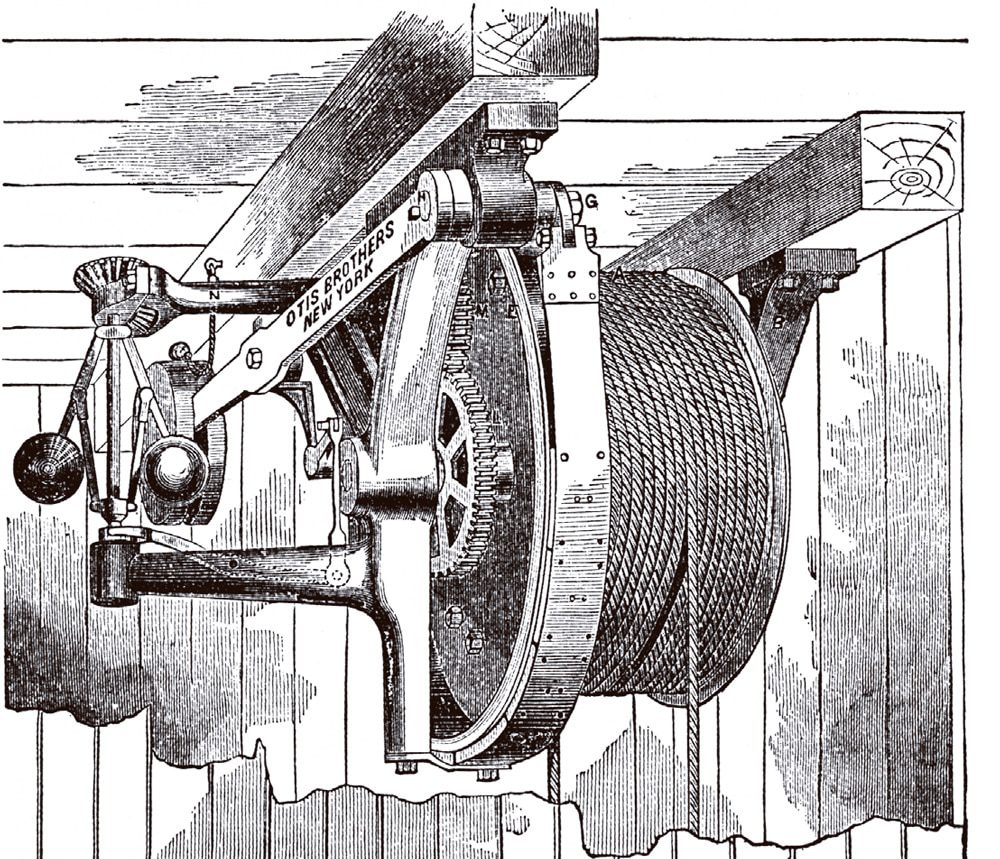
It was at the Maize & Burns factory that Otis realized the need for a lift to move heavy equipment to the upper floors. While lifts existed in the 19th century, they weren’t entirely safe. Otis became fascinated with the idea of creating a safe lift, and after some time, he invented a safety elevator that automatically stops if the hoisting rope breaks.
Founding His Own Company
Otis worked at Maize & Burns for only one year before leaving to start his own company, the Otis Elevator Company. It was at his company that Otis finally got to demonstrate his “safe elevator.” Initially, the product didn’t sell well; people were afraid to use the lifts. But the inventor was not discouraged.
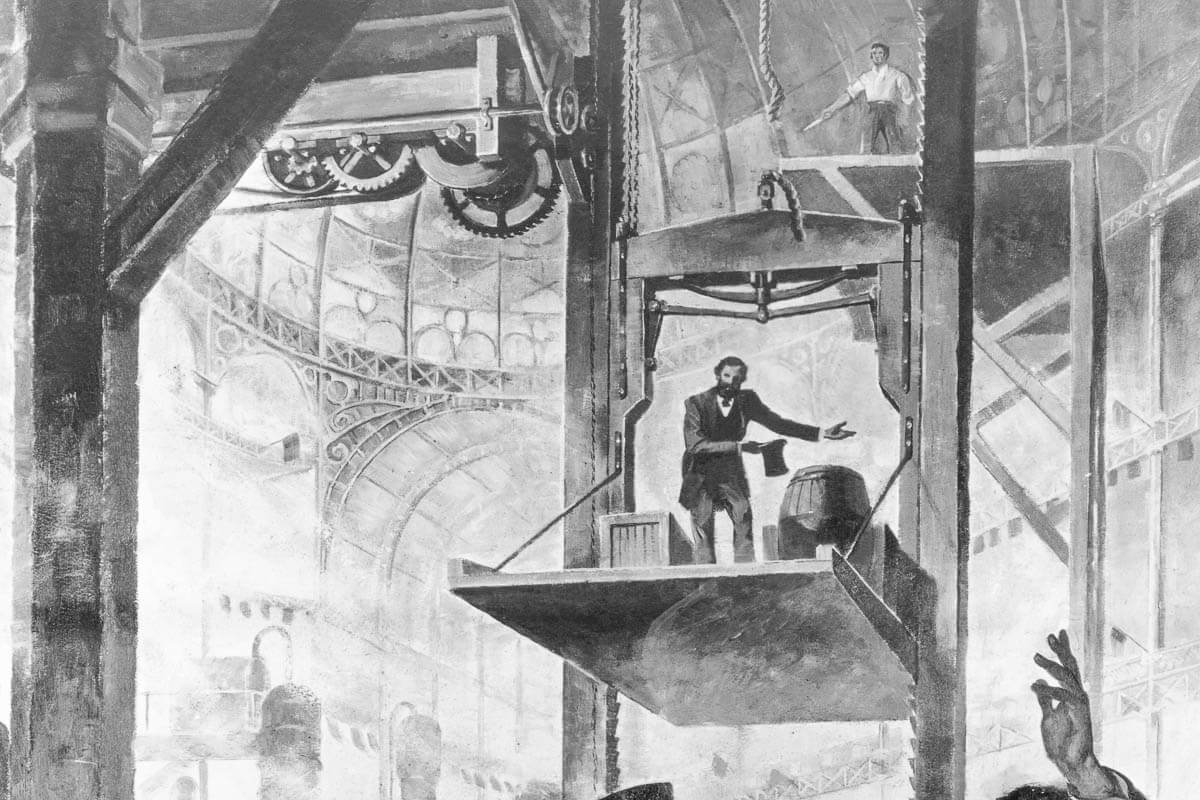
To boost sales, Elisha Otis arranged with showman P.T. Barnum to exhibit his invention in New York during the “Exhibition of the Industry of All Nations,” widely known as the “Crystal Palace Exhibition.” At the crowded exhibition, Otis assembled his elevator, loaded heavy barrels and a safe onto the platform, and stepped onto it himself. Standing high above the crowd on the platform, which was about 30 feet (10 meters) high, Otis signaled an assistant to cut the hoisting rope. The platform dropped a few inches, and the crowd screamed. But the safety brake that Otis had developed instantly stopped the descent. “All safe, gentlemen, all safe,” Otis assured them.
The company sold eight elevators in 1854 and fifteen in 1855. In 1857, Otis installed his first passenger elevator in New York’s E.V. Haughwout Building, a five-story department store whose wealthy clients included Mary Todd Lincoln.
Besides inventing and improving elevators, Elisha spent his free time working on his old projects for baker’s ovens and railroad brakes. In 1857, he patented a steam plow. In 1858, he developed a rotary oven, and in 1860, he and Charles developed a reciprocating steam engine. The plow, unfortunately, was not a commercial success.
The “Safe Elevator” Specifics
Otis worked on the lift for months, and his efforts paid off. To make the lift safer, Otis attached the rope to the elevator platform via a flat leaf spring (a flexible suspension component used to absorb shock and reduce vibration). He also installed toothed rails on the sides of the hoistway. Under the weight of even an empty platform, the spring would bend and pass smoothly between the toothed rails. If the cable broke, the spring would instantly straighten, its ends getting stuck in the teeth of the rails, preventing the platform from falling.
The Modern Otis Company
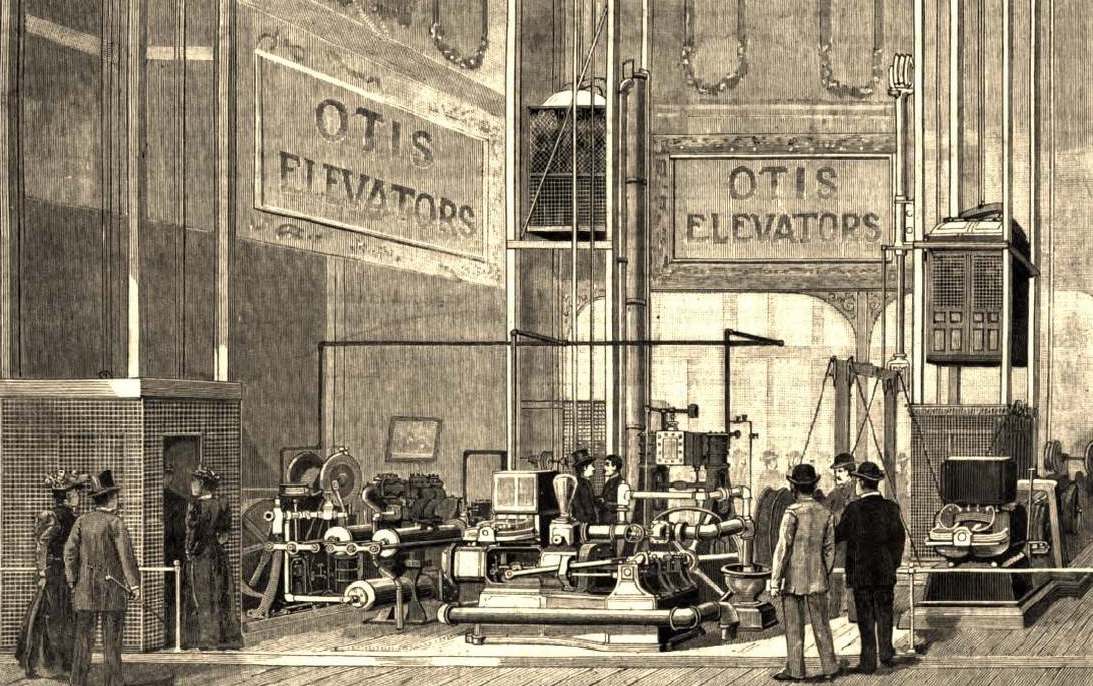
Otis’s sons continued their father’s work and founded the world-renowned Otis company, which manufactures and installs elevators. Today, the company has 71,000 employees, including 42,000 field service professionals. Otis elevators can be found in many of the world’s most recognizable buildings, as well as in the busiest transportation hubs and shopping malls. The company is present wherever people are on the move.
Until recently, the company owned the two tallest elevator test towers in Shibayama, Japan (505 feet/154 meters above ground; 88 feet/27 meters below ground), and Bristol, Connecticut, USA (384 feet/117 meters high).