

She was the first programmer for the American computer “Mark I,” known as “Amazing Grace” and the “Grandma of COBOL.” At just seven years old, she was taking apart alarm clocks to understand how they worked. All of this perfectly describes the talented and incredibly intelligent New Yorker Grace Hopper. Technology was a part of her life, and the contributions she made to scientific research and the military were truly immense. Think technology is just for men? This American trailblazer boldly shattered that myth and helped many of her admirers believe in themselves. Learn more on new-york-future.
Grace Hopper’s Childhood, Education, and Military Career
Grace Hopper was born into a wealthy family on the Upper East Side of New York City on December 9, 1906. Her grandfather was a construction engineer, her father worked at an insurance company, and her mother was a mathematician. Grace was a very active and curious child; at age seven, she became fascinated with how alarm clocks worked and proceeded to take apart every one her parents bought for her. She finished both school and college in her native New York and began her career as a mathematician. She went on to get her graduate degree at the prestigious Yale University. In 1930, she earned her master’s degree after writing a dissertation on algebra.
The year after graduation, Grace worked as a math professor at Vassar College, but her life changed dramatically when the U.S. entered World War II. She volunteered for the Navy, was commissioned as a lieutenant junior grade, and was assigned to the Bureau of Ordnance Computation Project. There, she had her first introduction to computers. The lab housed the first American programmable computer, the “Mark I,” which had been developed in 1941.
From then on, Grace Hopper’s life was intertwined with the Navy. She reached the rank of rear admiral and received numerous honors. Among her most prestigious awards were the Defense Distinguished Service Medal (1986) and the National Medal of Technology (1991).
Grace Hopper’s career in the scientific field was also exceptional. While working at the Harvard Computation Laboratory, she co-authored three papers on the “Mark I” computer with Howard Aiken. In 1949, the renowned New Yorker worked at the Eckert-Mauchly Computer Corporation, where she served as a mathematician and helped develop the “UNIVAC I” computer. In the 1950s, Hopper and her team created the world’s first compiler, which is a computer program that translates source code written in one programming language into an equivalent code in another language, typically one required for the machine to execute the program. Grace Hopper’s creation was officially named the “A-0 System” compiler.
Grace Hopper’s Teaching Career and Final Years
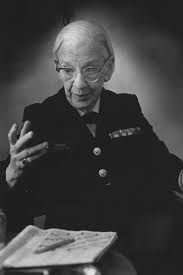
Grace Hopper considered her greatest achievement not the creation of the compiler, but her contributions to teaching. She was a truly wonderful educator, and all of her students recalled that she never left them without support. As a teacher, Grace Hopper had a unique characteristic: although she taught mathematics, she required her students to be good writers. For example, when she wrote the Stirling formula on the board in a probability class and assigned them an essay about it for homework, the students complained. Grace Hopper’s response was, “There’s no point in learning mathematics if you can’t communicate your knowledge to others effectively.”
Grace Hopper always gave her lectures in her military uniform, even after she retired. She was a frequent speaker at events dedicated to new technologies, where she often spoke about her service during the war.
The talented programmer passed away on New Year’s Eve in 1992 in Arlington, Virginia. She was 85 years old. Grace Hopper was buried with full military honors in Arlington National Cemetery.