

Higher education has plenty of supporters and opponents. Some people truly believe that you can’t get a good job without a college degree, while others argue that a university education isn’t essential. The story of American inventor Luther Simjian is amazing because he created one of the most important inventions in human history without any formal technical or higher education. All he had was a drive to make people’s daily lives easier and a great passion for his work. Luther Simjian was the one who created the now-familiar ATM, even though few believed in its success at first. Read more at new-york-future.
Key Facts from the Inventor’s Biography
The inventor’s birth name was Karekin Simjian. He was born in the Ottoman Empire on January 28, 1905. From childhood, the future inventor showed a great interest in optics and photography, but his youth coincided with the Armenian Genocide, during which he lost his parents. At 15, Karekin Simjian found himself in New Haven, Connecticut. He stayed with relatives and began to support himself by working as a photographer.
After finishing school, Simjian planned to study medicine, but his plans changed when the Yale School of Medicine offered him a job in their photo lab. In 1928, he was appointed director of photography for the medical school and went on to develop a way to project microscopic samples and photograph underwater.
In 1934, Luther Simjian moved to New York City, where he developed a color X-ray machine and a self-adjusting portrait camera that allowed the person being photographed to look into a mirror and see what their picture would look like. In 1939, Luther founded his own company, Reflectone Co., for the mass production of his new devices. The company existed for about 65 years before British Aerospace bought it for $90 million.
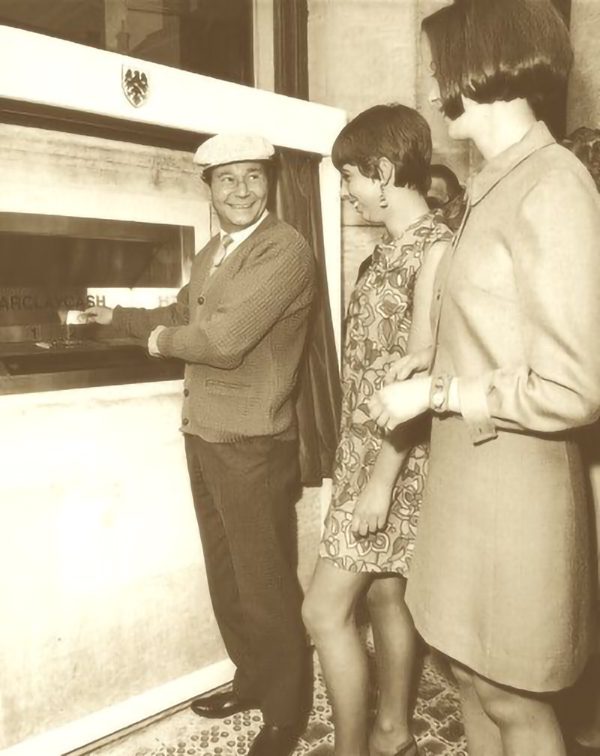
In 1939, Luther Simjian had the idea to develop an automated cash dispenser, which he called the “Bankograph.” However, almost all New York banks refused to work with him. As he later recalled, this was because banks believed the machines would only be used by gamblers and prostitutes who didn’t want to be seen by a teller. The number of these people was not enough for Simjian’s invention to be profitable. During the development of the ATM, Luther obtained 20 patents and created a number of key technological solutions that were only widely used years later. Eventually, Luther managed to get a contract with City Bank of New York, but it only lasted for a year and was not renewed due to lack of demand. The conservatism of American banks and their customers led to the failure of the world’s first ATM, and Luther Simjian did not become a popular inventor.
Luther Simjian’s Work After World War II and His Last Years
Simjian’s inventions span more than 30 technical fields. For example, after World War II, he introduced a device that helped pilots navigate during night flights, as well as several important medical developments that aided in ultrasound therapy. Throughout his life, Luther Simjian never stopped inventing in his New York laboratory. Only the loss of his eyesight at age 92 forced him to stop. It was then that he received his final patent for a process to improve the sound of wood for musical instruments.
On October 23, 1997, the brilliant inventor passed away in Florida, where he also had his own lab. Although Donald Wetzel and John Barron are often credited with inventing the ATM, we owe it to Luther Simjian for coming up with the original idea for this important technology.